Use baseball to recognize cricket's batter-versus-bowler contest, then learn the different rules for runs, overs, wickets, and innings. For a first look, follow one over of a T20 match with the scoreboard open.
Cricket vs. baseball at a glance: where the analogy holds
If you know baseball, the opening scene of a cricket match feels reassuringly familiar. Someone delivers a ball. Someone else tries to hit it. Fielders wait for a chance to stop a run or dismiss the batter.
The resemblance helps during the contest between bowler and batter. It gets less reliable when you try to interpret the score, batting order, or what brings a team's turn to an end.
A baseball comparison explains bats, runs and fielders, but the complete cricket match overview connects those elements to an innings and the wicket.
| Feature | Cricket | Baseball | Where the analogy changes |
|---|---|---|---|
| Batting | Two batters occupy opposite ends of a pitch | One batter faces the pitcher; runners may occupy bases | A cricket batter can stay at the crease across many deliveries |
| Scoring | Runs between wickets; boundaries worth four or six | Runners score by completing the bases | Both sports say run, but they score it differently |
| Innings | A team's batting turn | An inning contains a batting half for each team | A cricket innings is one team's turn; a baseball inning gives each team a turn |
| Deliveries | Six legal balls make an over | Pitches occur within plate appearances | Cricket counts balls in overs; baseball counts outs |
| Dismissals | Bowled, caught, LBW, run out, stumped, and others | Strikeout, fly out, force out, tag out, and others | Different ways to get out; cricket has no three-strike count |
| Fielding side | Eleven players, including the wicket-keeper | Nine defenders, including the catcher | Cricket fields two more players |
| Playing area | A central pitch with shots played around the ground | A diamond and fair territory bounded by foul lines | Cricket has no foul territory |
| Match structure | T20, ODI, and Test have different innings arrangements | Regulation MLB uses nine innings | Cricket match length depends on the format |
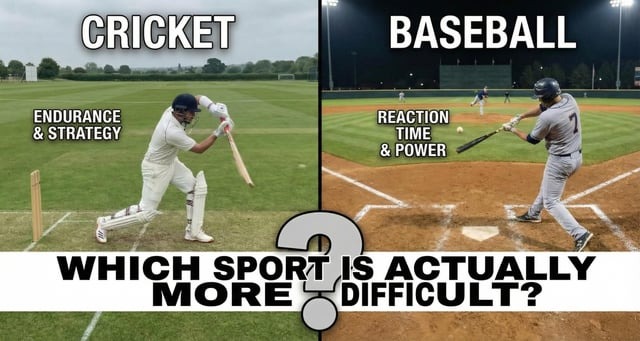
An American fan preparing to watch Netherlands against South Africa in New York described learning cricket through baseball comparisons:
I'm a US sports fan, and I've never really paid attention to cricket. Because NY was going to be hosting some games, I decided I wanted to watch one in person (Netherlands vs South Africa), and I watched some explainer videos and bought a one-month subscription to Willow so I could watch some matches and not go to Nassau completely blind. I think Americans assume cricket is a crazy complex sport that's impossible to understand. I disagree. I think the issue is that there are enough similarities with baseball that people think they should easily be able to understand cricket, but the differences require a brand-new perspective. But I think that if you wanted to explain cricket and baseball to someone who knows nothing about either sport, explaining cricket would be way easier.
Runs, fours, sixes, and home runs
Cricket batters score by running between the ends of the pitch, and a ball that reaches the boundary earns four or six runs. Baseball runners must advance around four bases and reach home.
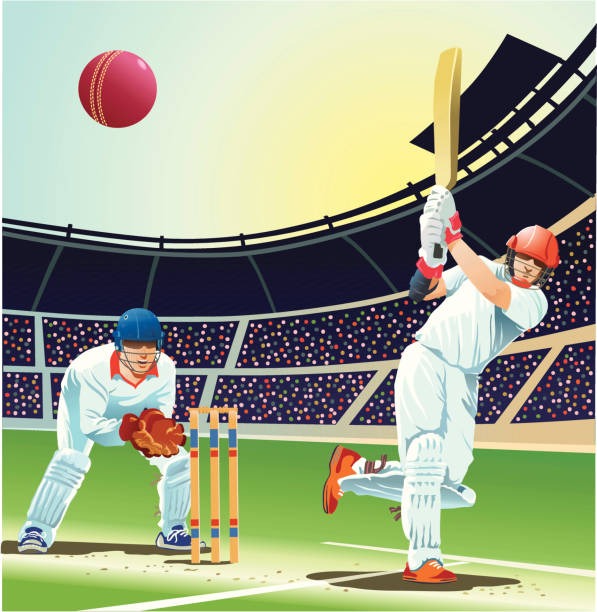
Imagine a cricket batter facing three different deliveries.
- One run: The batter plays the ball into an open area. Both batters run to the opposite ends of the pitch and safely complete the exchange.
- Four runs: The batter drives the ball through the field. It touches the ground and reaches the boundary, so the batters earn four runs without running four times.
- Six runs: The batter hits the ball over the boundary without it touching the ground first. That is six runs.
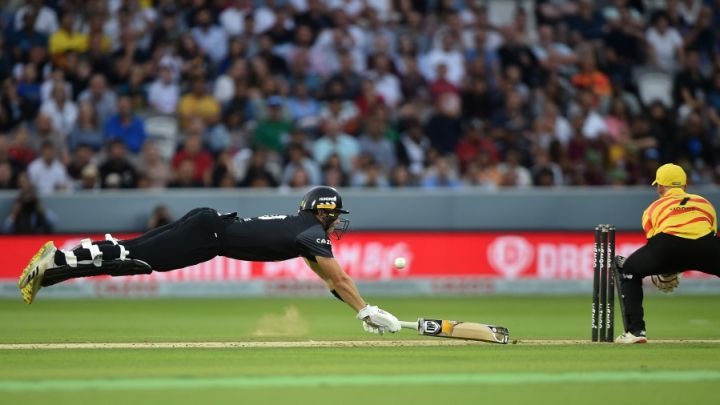
Batters can also decline to run. A nearby fielder may stop the ball and leave no safe chance to swap ends, so the delivery adds no run. Setting off when fielders can reach the wicket first risks a run out.
A baseball home run works differently. The batter circles the bases, and runners already on base score too. With nobody aboard, a home run produces one run. With three runners aboard, it produces four.
A cricket six is worth six runs no matter how many teammates are waiting to bat. Extras and overthrows add runs in other ways.
Innings, overs, and batting turns
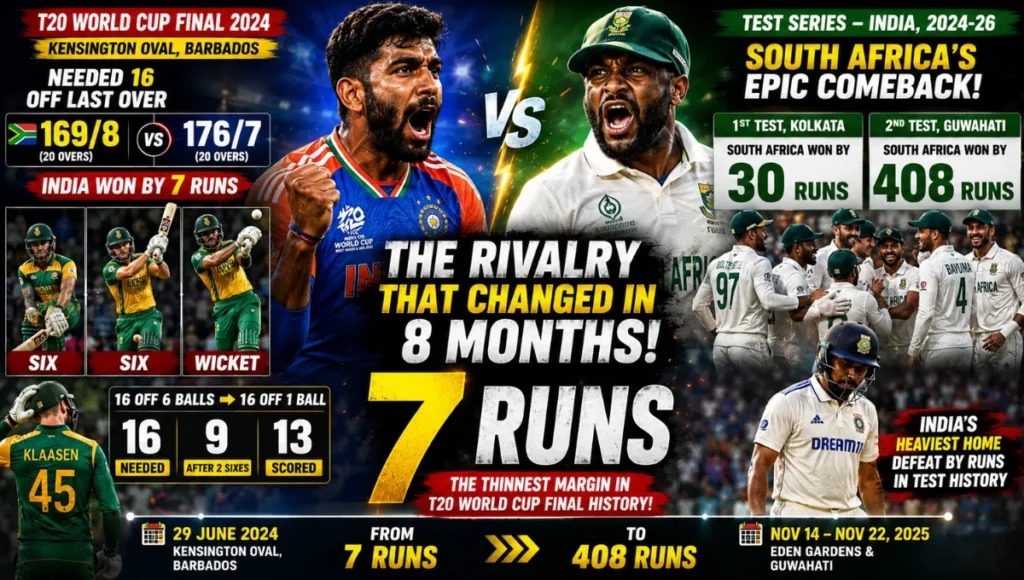
A cricket innings is a team's turn to bat. A baseball inning contains a batting turn for each team, with a top half and a bottom half.
In MLB, each half-inning ends after three outs, and a standard game runs nine innings.
Cricket organizes deliveries differently. An over contains six legal balls. When an over ends, another begins within the same innings. Wickets are tallied separately from balls.
Take a score of 17.3 overs. The 17 is completed overs and the 3 is legal balls in the current over. Seventeen completed overs contain 102 legal balls, and three more make 105.
A T20 innings of 20 overs allows 120 legal balls in full. Wides and no-balls are not legal balls, so an over can take more than six deliveries.
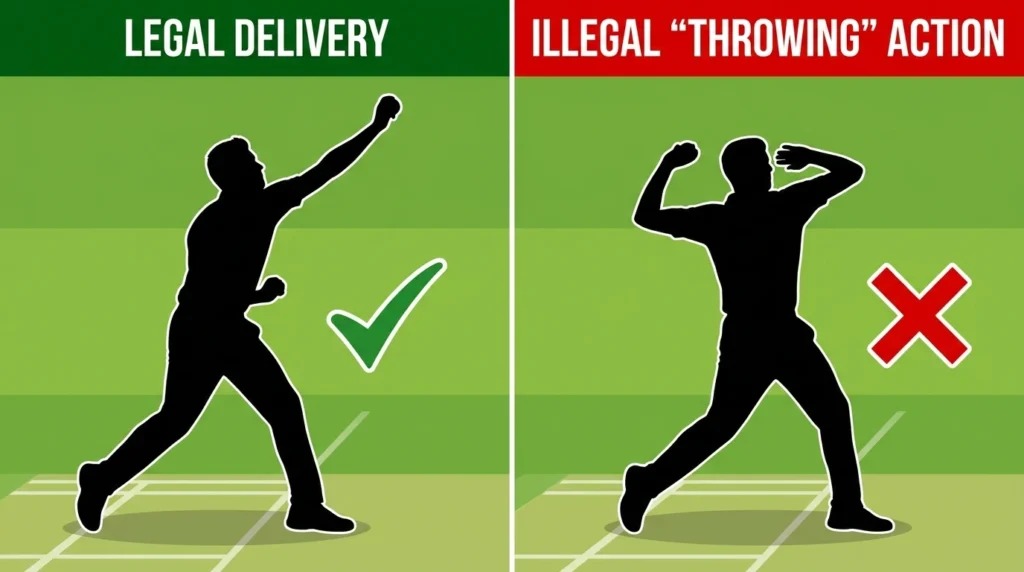
Cricket's main international formats impose different innings structures:
- T20: One innings per side, up to 20 overs each.
- ODI: One innings per side, up to 50 overs each.
- Test: Two innings per side, with a different match structure and no fixed 20-over or 50-over limit.
A limited-overs innings ends early if the batting side is all out or reaches its target. Test cricket also allows declarations.
The ICC's explanation of the three formats provides more context. For legal deliveries and notation, see cricket overs and legal balls.
Wickets and outs: what ends a batter's turn
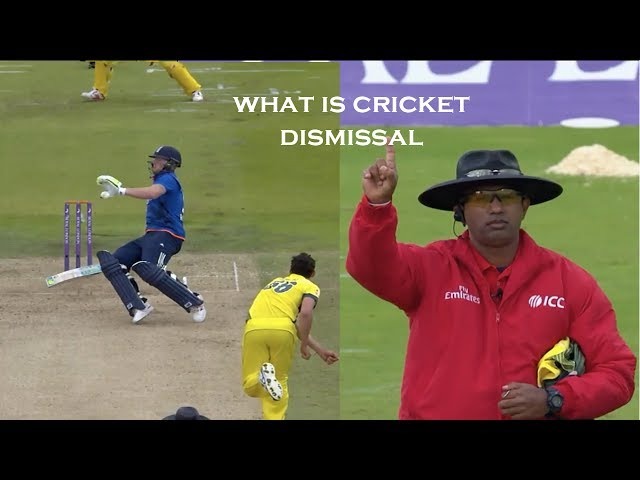
Cricket uses wicket in several related ways. It can refer to the stumps and bails, a batter's dismissal, or an aspect of the playing surface. On a scoreboard, wickets lost means batters dismissed.
A standard cricket team has eleven players. An innings ends when ten batters have been dismissed, leaving the remaining batter without a partner. A baseball batting half ends with three outs.
| Cricket dismissal | What happens | Baseball comparison |
|---|---|---|
| Bowled | The delivered ball puts down the batter's wicket | No exact strikeout equivalent |
| Caught | A fielder completes a lawful catch before the struck ball touches the ground | Looks like a caught fly ball |
| Run out | The wicket is fairly put down while a batter is out of their ground | Comparable to a tag or force play, played differently |
| LBW | An umpire applies the leg-before-wicket test to a ball intercepted by the batter's body | No direct counterpart |
| Stumped | The wicket-keeper puts down the wicket while the batter is out of their ground | No direct counterpart |
A baseball batter strikes out after a third strike. Cricket has no three-strike count. Missing a delivery does not dismiss the striker, who can keep batting across many deliveries until dismissed or the innings ends.
In baseball, the batting order cycles through successive plate appearances. A dismissed cricket batter does not return to bat in the same innings.
A batter hits a boundary four, refuses a risky run on the next delivery and keeps batting. Later, the other batter attempts a run and is dismissed when the fielding side puts down the wicket. Both events happen in the same innings, and the wicket count changes on the dismissal.
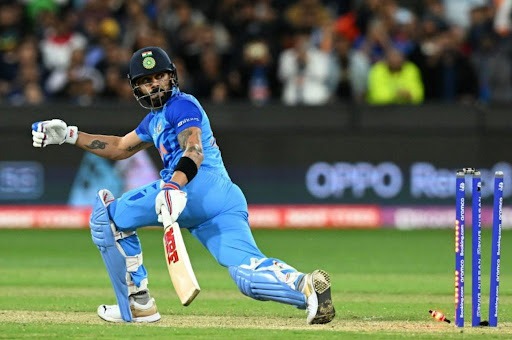
In its October 8, 2026 run-out clarification, MCC explained that a ball striking the wicket directly can put it down without a fielder controlling the ball. When a fielder breaks the wicket with a hand or arm holding the ball, complete control of that ball is required; a run out also depends on the other dismissal conditions.
When you see a dismissal, identify the cause. A catch, a ball hitting the stumps and a run-out attempt each follow different rules and umpire decisions.
Bowling and pitching: bounce, line, and length
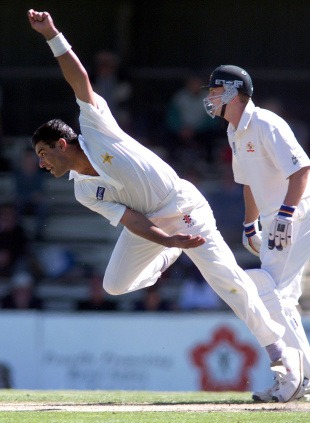
The bowler and the pitcher hold comparable roles, but they deliver the ball under different rules and pose different problems for the batter.
A baseball pitcher throws toward home plate and works against the strike zone and the ball-strike count. A cricket bowler must follow regulated bowling-action rules and often uses the pitch surface to change what the batter faces.
Cricket commentators talk constantly about line and length. Line describes the delivery's side-to-side placement relative to the batter and wicket. Length describes where the ball lands before reaching the batter.
A fuller delivery lands closer to the batter. A shorter one lands farther away, producing a different bounce and demanding a different response.
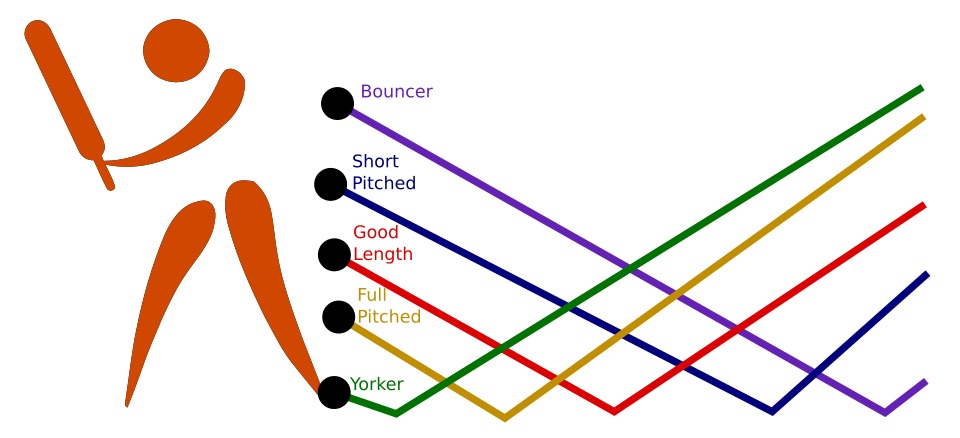
A batter has to decide whether to drive a fuller ball or react to a shorter one that rises after pitching.
Some deliveries are full tosses and reach the batter without bouncing.
The MCC Laws of Cricket govern cricket's delivery and dismissal rules. Baseball's pitching rules are defined separately by MLB.
On a replay, watch where the ball lands and how its path changes before it reaches the batter. That makes line and length easy to spot.
The wicket-keeper stands behind the batter's wicket to receive deliveries and field. The position looks like a catcher's, but the rules differ.
Fields, fielders, bats, and distances

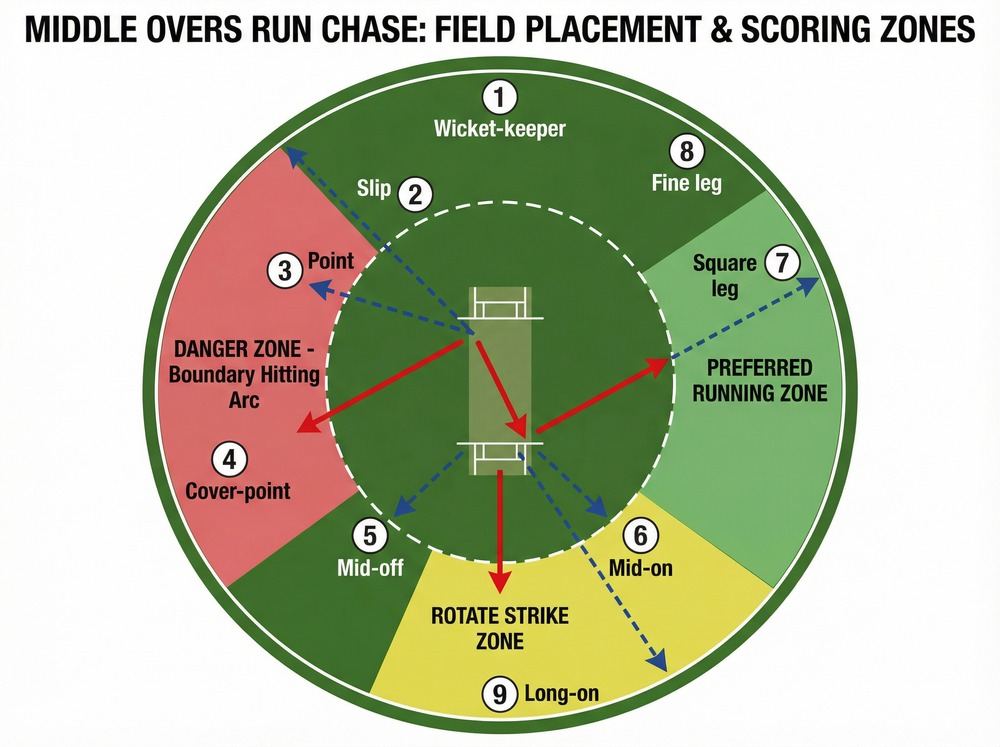
A narrow pitch sits in the middle of a much larger ground, often roughly oval. Fielders stand all around the batter because shots travel in every direction.
Baseball is organized around its diamond, bases, and fair territory defined by foul lines. Cricket has no baseball-style foul-territory wedge. A batter can hit the ball anywhere around the ground, including behind the striker.
Cricket has eleven fielders on the defensive side, including the wicket-keeper. Standard MLB defense has nine, including the catcher. Cricket field placements change according to the bowler, the batter, and the stage of the innings.
A cricket bat has a broad, flat striking face. A baseball bat is rounded. Baseball defenders wear fielding gloves. Ordinary cricket fielders catch barehanded, while the wicket-keeper wears specialist wicket-keeping gloves.
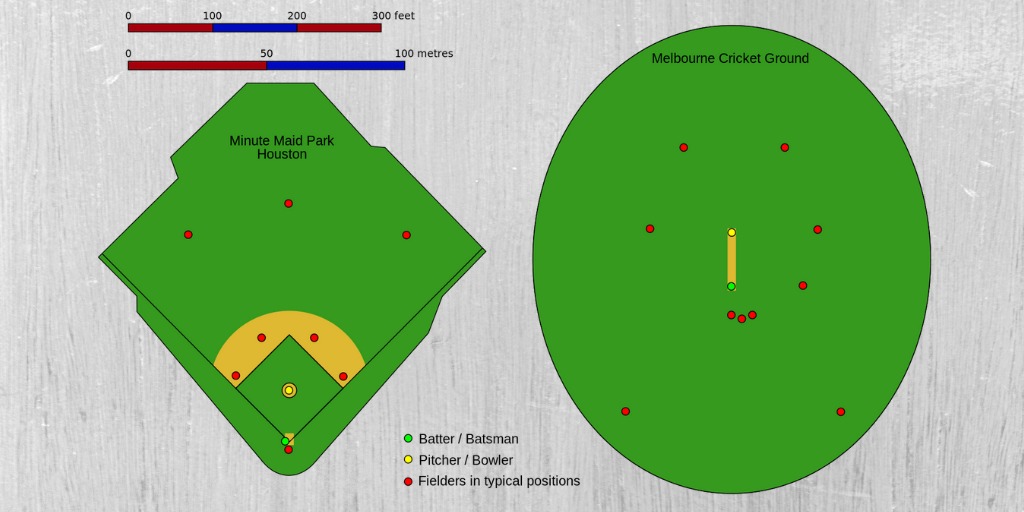
Cricket's 22 yards is the length of the pitch between the wickets. MLB's numbers describe the diamond and the pitching area, so the two sets of distances measure different things.
Cricket boundary shapes and distances vary by ground. MLB's official field-dimensions guidance describes the standard infield arrangement.
The MLB diamond has 90-foot basepaths. The distance from the pitcher's rubber to home plate is 60 feet 6 inches.
How to tell who is ahead in cricket and baseball
Baseball tension often comes from the inning, the count, the number of outs, and runners on base. A limited-overs cricket chase raises different questions: How many runs are required? How many legal deliveries remain? How many wickets have fallen?
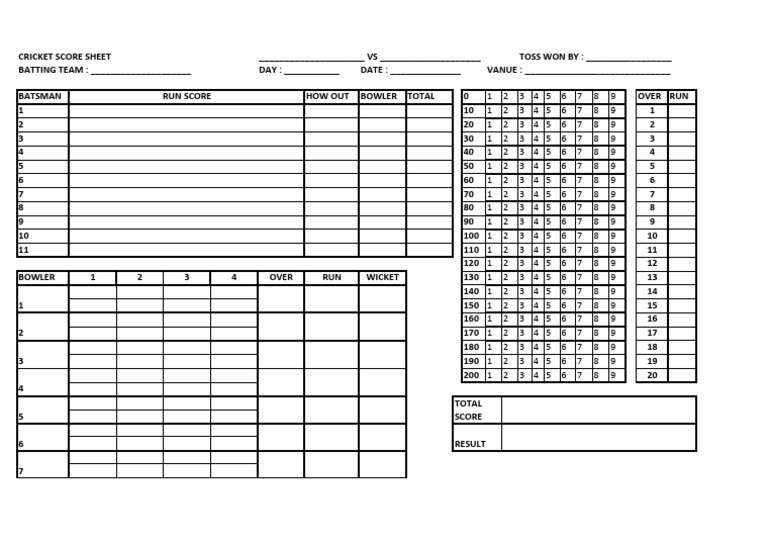
Here is a fictional T20 scoreboard:
Batting side: 162/4 after 17.3 overs. Target: 181. Format: T20, with a full 20-over allocation and no reduced-overs adjustment.
The batting side has scored 162 runs and lost four wickets. To win, it needs to reach 181, leaving 19 runs required. With 105 legal balls bowled, 15 remain.
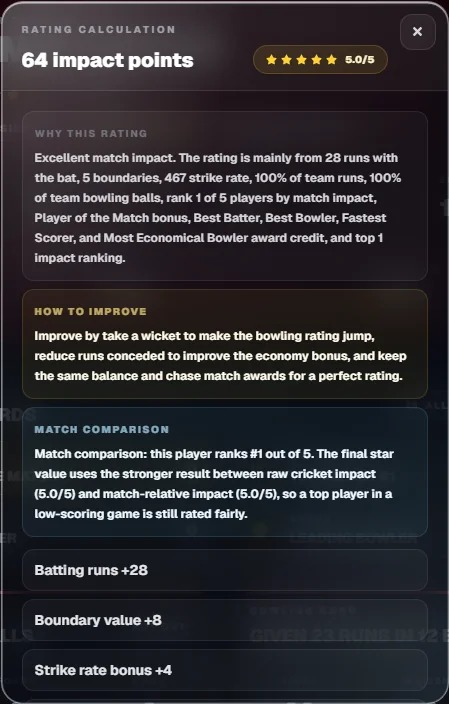
Those 15 legal balls are two complete overs and three balls, written 2.3 in cricket over notation. For a required-rate calculation, convert them into decimal overs: 15 ÷ 6 = 2.5. The required scoring rate is 19 ÷ 2.5 = 7.6 runs per over.
Wickets in hand and the batters still to come matter too. A score of 162/4 (17.3) alone does not tell you who is likely to win.
A cricket captain changes bowlers according to the match situation. A baseball manager makes pitching changes, substitutions, and defensive-positioning decisions, while the pitcher chooses how to attack the next batter.
One first-time viewer found the familiar appeal of the duel at the center of the game:
Wow. This is rad. It's similar but so different. I keep watching and seeing so many overlaps. It makes me wonder if some cricket players play baseball or vice versa. My favorite aspect of baseball is "the duel" - one pitcher and one batter as they compete against each other in a battle of mental, physical, and willpower. What I'm liking about cricket is that this is more front and center of the game with less of an outfield. It's just the pitcher versus the batter from what I see and it's riveting. I love it. Tell me more!
Can baseball skills carry over to cricket?

Baseball helps with tracking a moving ball and timing a swing. Cricket asks for different decisions about bounce, shot selection, and protecting the wicket. Before trying hard-ball cricket, check the ball type, wear suitable protective equipment, and start with supervised beginner coaching through a beginner route into cricket.
Your first cricket match: what to watch
T20 is a good starting format for a baseball fan because its fixed overs make the innings easy to follow from start to finish. Some viewers prefer the longer tactical build of an ODI or Test match.
Watch the delivery first, since you already know that contest from baseball.
An American baseball fan described discovering the women's ODI format while watching a televised tournament in 2022:
So the Women’s World Cup has been playing on ESPN+ and as such it has been popping up on my Hulu front page. Being American I’ve never understood Cricket. It of course has similarities to baseball, which I enjoy, but not enough for me to understand what is happening. So I decided to click on a game, don’t remember who was playing (I think New Zealand because I remember the name Tahuhu), in order to try and figure out the rules. 2 hours I realize I am entranced. I loved it. And I slowly pieced together some of the rules just from watching. Others (like how the wickets work and I love how they light up) I had to google to find out. I had heard that cricket matches could last days, and was confused how that could happen and that led me to learn of the 3 different types and how what I was watching was called ODI.
Start with a broadcast or replay and identify its format. To read a full scorecard, see reading a cricket scoreboard. If the match structures are still confusing, compare T20, ODI, and Test cricket.
The first cricket over is where the two games start to feel different. Watch the pair of batters, the legal-ball count and the score together. Those details teach you more than forcing every cricket term into a baseball equivalent.