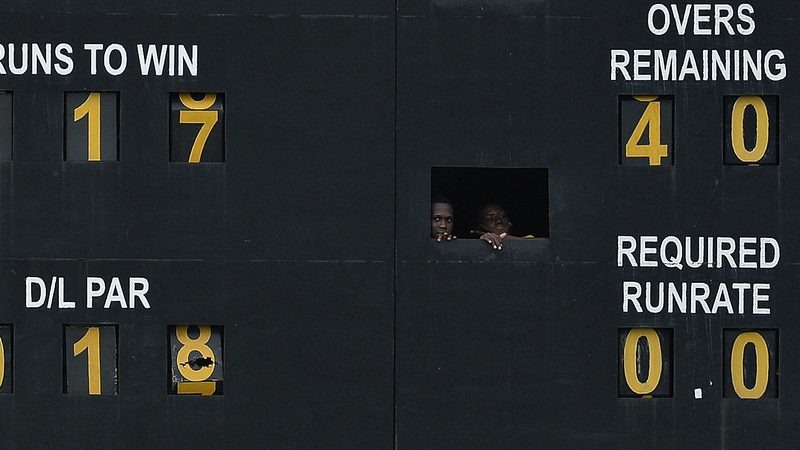
Enter the winning target, the runs scored and the legal balls left. The calculator returns the runs needed and the required run rate. The cricket scoreboard walkthrough shows where runs, wickets and overs appear on screen.
Worked T20 chase: The team batting first scores 180. The chasing team has 120 after 13.0 of its 20 overs, with a winning target of 181.
It needs 61 runs from 42 legal balls, with 60 runs needed to level the scores. Its required run rate is 8.71 runs per six-ball over.
Cricket chase calculator: enter the target, score and overs
Interactive chase and required-run-rate calculator
Enter the winning target, not the first-innings score. In rain-shortened matches, use the official revised target and allotted overs. The tool does not calculate a DLS target or a result after abandonment.
Enter match figures, then select Calculate chase.
A chase calculation needs the winning target, the chasing side's current total and the legal balls available.
Suppose the opposition scored 180. In an uninterrupted chase, the chasing side needs 181 to win. If the scorecard says "Target: 181", use 181 as it stands.
You need four inputs:
- Target to win: The total the chasing side must reach to win.
- Current score: The chasing side's runs so far, including credited extras.
- Allotted overs: The overs assigned to the innings. A standard T20 has 20; a standard ODI has 50.
- Overs used: The completed overs and legal balls already delivered, in cricket notation such as 13.0 or 17.3. A direct count of legal balls works too.
A 20-over innings has 120 legal balls; a 50-over innings has 300. In a shortened match, the officially allotted number sets the balls available. Wickets do not enter the formula. Ten lost ends the chase.
The tool rejects these entries:
| Entered information | Treatment | Reason |
|---|---|---|
| 20.1 overs used in a 20-over allocation | Reject as inconsistent | More legal balls are recorded than the innings allows. |
| Target 0, negative values, or fractional runs or ball counts | Reject the entry | A target to win must be a positive whole number; scores and ball counts must be nonnegative whole numbers. |
Partial overs convert to legal balls as shown in the overs notation explanation below.
How to calculate the runs needed and required run rate
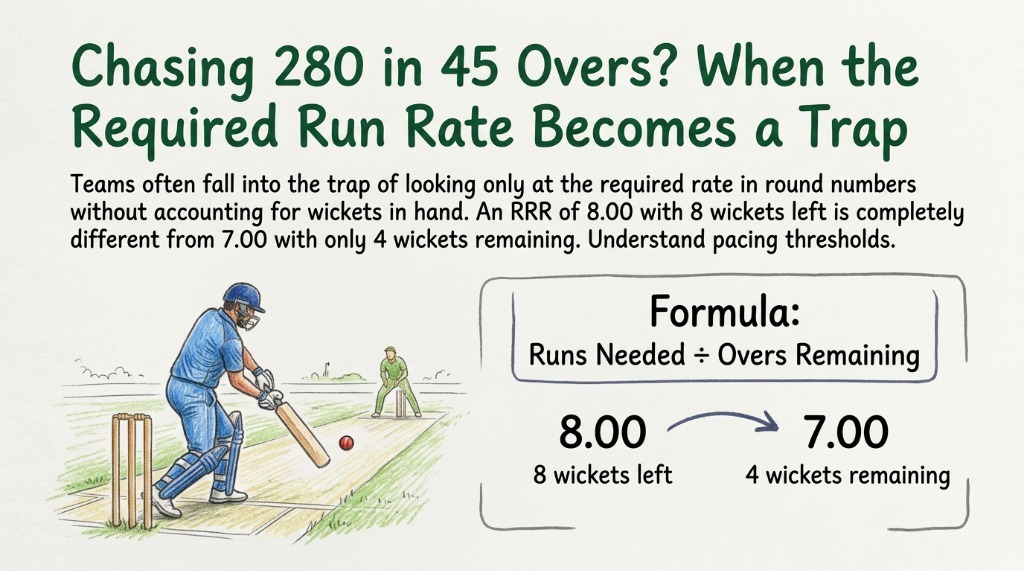
Required run rate, or asking rate, is the average number of runs per over the chasing side must score from its remaining legal balls to reach the target.
For an active chase:
Runs to win = target to win - current score
Required run rate = (runs to win × 6) ÷ legal balls left
Take the 20-over example above: target 181, score 120, 13 complete overs used.
The side needs 181 minus 120, or 61 runs. It has 120 legal balls in the innings and has used 78, leaving 42.
61 × 6 ÷ 42 = 8.714285...
Rounded to two decimal places, the required rate is 8.71 runs per over.
The rate is an average. A side can take 14 off one over and 2 off the next. Only the total counts.
Current run rate measures runs already scored per six legal balls used:
Current run rate = (current score × 6) ÷ legal balls used
The current rate is undefined before the first legal delivery, including when wides or no-balls have already added runs.
Why 17.3 overs means 105 legal balls
Over notation counts legal balls after the period. Under the standard six-ball rule in the MCC Laws of Cricket, 17.3 means 17 completed overs and three legal balls into the next over.
The conversion:
17 × 6 + 3 = 105 legal balls
In a 20-over innings, 120 legal balls are allotted. After 17.3 overs, 15 remain.
| Scorebook notation | Legal balls used | Interpretation |
|---|---|---|
| 5.1 | 31 | Five completed overs and one legal ball |
| 17.3 | 105 | Seventeen completed overs and three legal balls |
| 17.6 | Invalid entry | Six legal balls complete the next over, displayed as 18.0 |
| 20.0 | 120 | Twenty completed overs |
The digit after the period runs from zero to five. Reading the scorebook number as a decimal gives the wrong ball count.
For example, 36 runs after 5.1 overs means 36 runs in 31 legal balls. The current run rate is 36 × 6 ÷ 31, or 6.97 runs per over.
A chasing side that still needs 61 runs with 17.3 of 20 overs completed has 15 legal balls left. The asking rate is 24.40, against 8.71 when 42 balls remain.
The calculations here use the standard six-ball over.
Runs to win, runs to tie, and completed innings
With a winning target of 181, reaching 180 brings the chasing side level with the opposition; 181 completes the chase.
While the chase is active:
Runs to win = max(0, target - current score)
Runs to level = max(0, target - 1 - current score)
Take a side on 180 after 19.5 overs, chasing 181 in a 20-over innings. One legal ball remains. The scores are level, but the side still needs one run to win, an asking rate of 6.00.
| Chase situation | Match state | Live required rate |
|---|---|---|
| 180 after 19.5 overs; target 181 | Scores level, one run needed to win | 6.00 |
| 180 after 20.0 overs; innings complete | Final scores level | Not applicable |
| 181 reached before the allocation ends | Winning target reached | Not applicable |
| 120 after 20.0 overs; target 181 | Allocation exhausted, short of target | Not applicable |
| 120 after 19.0 overs; officially all out | Innings finished before its full allocation | Not applicable |
A live asking rate exists only while the chase is active and legal balls remain. After the innings ends, a rate would describe balls the side can no longer face.
An all-out state ends the chase despite unused overs. Level scores mid-innings settle nothing. Final level scores lead to a tie, a Super Over or another result procedure, depending on the competition.
How wides, no-balls and a final-ball finish change the chase
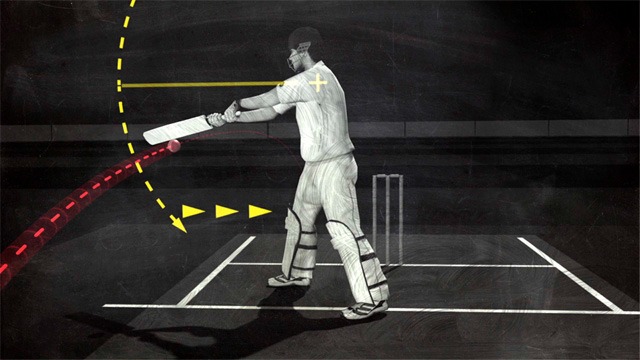
Wides and no-balls add to the score without using a legal ball. The runs needed change when those runs are credited; the legal-ball count changes only on a legal delivery.
Say a team needs 12 from six legal balls in the last over. The required rate is 12.00 runs per over.
The next delivery is a wide, and one extra run is credited with no other runs. The score rises by one, leaving 11 needed from six legal balls. The required rate falls to 11.00.
If the following delivery is legal and scores nothing, the side needs 11 from five.
A no-ball can also carry other runs, so add the whole delivery to the scorebook total.
A 1991 Natal v Transvaal semifinal gave an odd last-ball finish. Richard Snell later talked about it in a retrospective interview, and a Reddit commenter recalled how it went:
Transvaal v Natal, in the 90s. Natal needed 7 off 1 ball. Jonty Rhodes is facing Richard Snell. Snell bowled a high full toss and Rhodes hit him over square leg for 6. 1 needed off 1 (before the days where a NB or wide counted as additional to whatever runs were scored). Rhodes hit a 4 off the extra ball.
Extras are scored differently now, but an illegal last ball still leaves another legal ball to bowl.
Rain-shortened chases: official revised target versus DLS par score
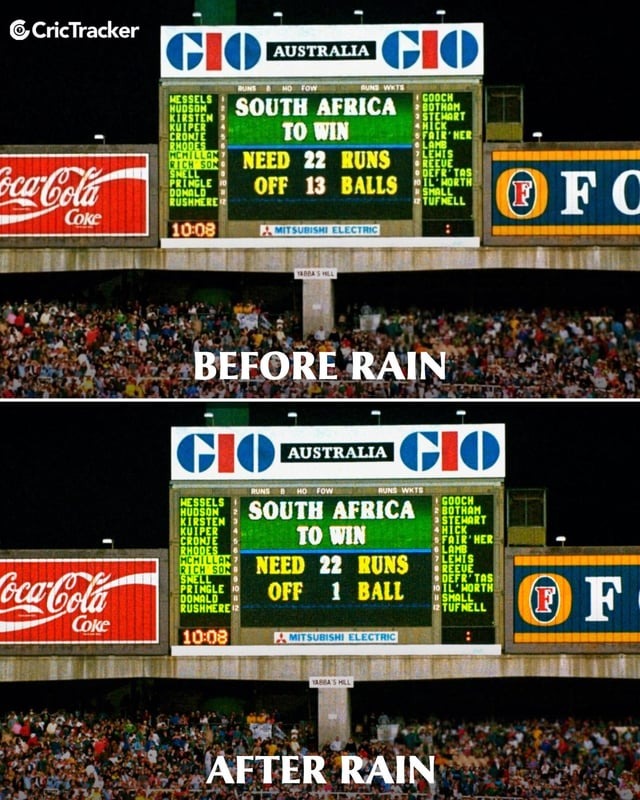
When rain reduces an innings and play resumes, the usual required-rate arithmetic works from the official revised winning target and revised allotted overs. The ICC Duckworth-Lewis-Stern method accounts for match resources, including wickets and overs, so the runs-and-balls equation cannot produce a DLS target by itself. If play is permanently abandoned, a DLS par score at the stoppage can decide the outcome. A par score is not a target for continued play.
Why your chase calculation differs from the scorecard
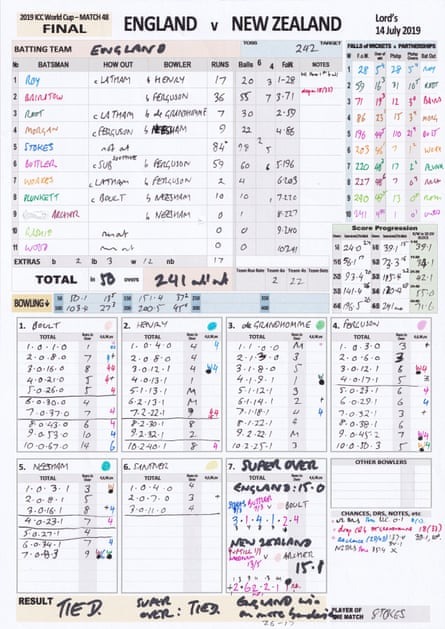
A mismatch with the scorecard traces back to the inputs.
| Discrepancy | Likely cause | Specific check |
|---|---|---|
| Runs needed differ by one | The first-innings total was entered as the winning target | Check whether the source shows 180 scored or a target of 181 |
| Rate differs after a partial over | Scorebook notation was treated as a decimal | Convert the completed overs and legal balls into a legal-ball count |
| Figures differ after a recent delivery | The score and over entries describe different moments | Compare both figures at the same match state |
| Rate changes unexpectedly after a wide | Runs changed without a corresponding legal ball | Check credited extras and the number of legal deliveries |
| A required rate appears after the innings ended | The completed or all-out state was missed | Confirm the officially recorded innings status |
| A rain-affected target differs | The original allocation or a DLS par score was entered | Find the official revised winning target and allotted overs |
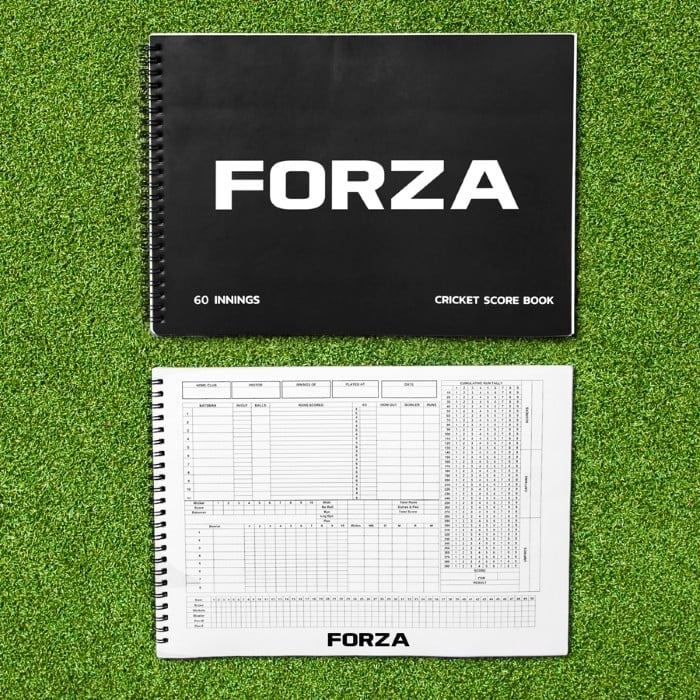
MCC Law 16.8 makes the umpires responsible for the scores. Laws 16.9 and 16.10 cover scoring mistakes that affect the result and are found after the players leave the field, and the limits on changing a result once umpires and scorers have agreed the final scores.
Line up the target, current total, legal-ball count, overs allotted and match status against the official scorecard. Fix the first confirmed difference, then recalculate.
The required rate shows how fast the chasing side must score from here. It does not predict the winner. After rain, start from the official revised target, overs and legal balls remaining.