Before you trust a cricket claim, match four things: the Law edition, the competition conditions, the match data and the definition of the statistic. If one of them doesn't fit, the claim isn't settled. Trace it to a dated primary source first.
Which cricket rules apply to a match?
Start with the match, then find who sets its playing conditions. Marylebone Cricket Club (MCC) is the custodian of the Laws of Cricket. International competitions, domestic leagues and local tournaments can adopt extra conditions that change how a provision works.
A disputed delivery needs two checks. First, find the document that governs the match. Then read the delivery against the clause that covers it.
If you spot a mistake in our rules or scorecard claims, the cricket editorial policy and correction procedure explains how we handle it.
| Match setting | Source to identify | What the source establishes |
|---|---|---|
| Underlying cricket Laws | Applicable MCC Law and edition | The general provision and its wording |
| International Test, ODI, or T20I | Applicable ICC Playing Conditions | Format and competition provisions |
| Domestic organized competition | Organizer's adopted conditions | Local additions and exceptions |
| Recreational tournament | Event rules and governing organizer | Conditions used for that event |
The ICC Playing Conditions catalogue lists international documents by format and competition. Which one applies depends on the match.
A tournament organizer's firsthand account shows why this matters:
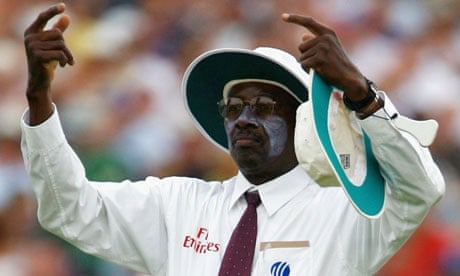
We are organising a cricket tournament. Today, the bowler bowled a bouncer, which went above the head of the batsman. The batsman tried to hit and nicked it. The umpire called it a no ball because the ball went over his head height. Is it out or should be called a no-ball?
You can judge the umpire's call only against the tournament's adopted conditions and the clause for that delivery. The Wide and No-ball comparison explains a delivery-scoring exception, but you still need the governing competition and date before you make a rule claim.
For an incident like this, write down the competition name, match date, format, governing organizer and adopted playing-conditions document before you assess the decision.
How to check editions, effective dates, and later clarifications
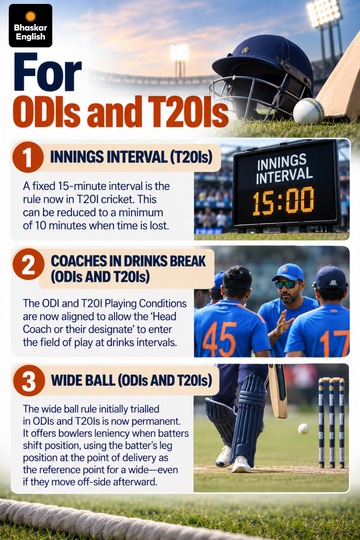
An authentic rules document can still belong to the wrong edition or series. Three dates do different jobs: the announcement date, the date a provision takes effect and the start of an international series.
| Date | Official event | Why it matters |
|---|---|---|
| February 3, 2026 | MCC announced the 2017 Code, Fourth Edition 2026, with 73 material changes | Identifies the edition and what MCC announced |
| October 1, 2026 | Revised MCC Laws took effect; updated ICC Playing Conditions began applying to international series starting on or after this date | Determines the effective changeover and series scope |
| October 8, 2026 | MCC clarified a provision concerning breaking the wicket for a run-out | Shows how an official interpretation can follow the edition's effective date |
The MCC announcement names the revised Laws and their October 1 effective date. The ICC changeover announcement says international series already underway continue under the earlier playing conditions. A series that begins on or after October 1 follows the revised conditions.
On October 8, 2026, MCC clarified how the wicket can be broken in a run-out. A fielder using a hand or arm while holding the ball must have complete control of it. If the ball itself strikes the stumps and dislodges the bails, that requirement doesn't apply. For tournament scoring and credited overs, see the net run rate guide, which doesn't cover run-out dismissals.
Where cricket scores and statistics come from
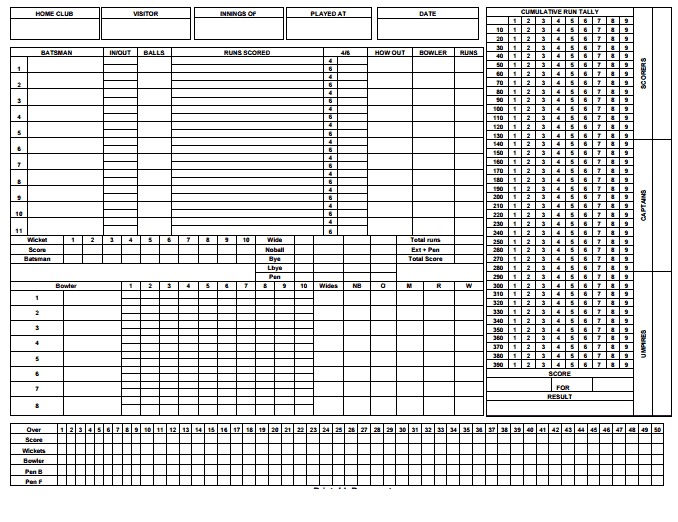
A cricket statistic means something only when you can identify its original record and the matches counted in it. A scorecard describes one match. A statistical aggregate summarizes a defined set of matches. A delivery-level dataset records the deliveries in its collection. Coverage and definitions decide what each one can support.
Cricsheet is an independent public source of structured match data. It documents missing matches where a competition or period falls outside its coverage, no trustworthy ball-by-ball source exists, or source records can't be reconciled. A total built from its matches can therefore differ from a broader career record.
A simple log pairs each claim with the fields needed to reconstruct it. This blank example shows what to capture for a match-derived claim.
| Record field | Entry to capture | Reason |
|---|---|---|
| Exact claim | Specific published sentence or figure | Defines what is being tested |
| Match or series | Competition, format, event, date | Identifies the relevant match population |
| Primary record | Original scorecard or direct source reference | Allows the figure to be traced |
| Dataset release | Provider, file format, version or release identifier | Identifies the data used when deriving a figure |
| Statistical definition | Field meaning, calculation inputs and units | Makes a derived number reproducible |
| Coverage and exclusions | Included formats, dates, omitted matches and special cases | Explains the scope of the result |
In an October 7, 2026 licensing announcement, Cricsheet said its JSON, YAML and CSV match data use the Open Data Commons Attribution License (ODC-BY), while XML match data uses Creative Commons Attribution 4.0 (CC BY 4.0). Those terms govern reuse of the provider's material. The dataset's coverage and underlying records set the factual scope of a statistic.
Does Cricsheet supply ball-tracking data or delivery timestamps?Its published data documentation says those attributes are unavailable.
Why two cricket numbers may not agree
Two credible statistics can disagree because their match populations, cutoff dates or counting conventions differ. Find out which definition each source used before you call the gap an error.
Cricsheet's data questions and coverage documentation gives one concrete cause: Super Over runs. Cricsheet excludes them from ordinary individual totals, so its player totals can differ from figures reported elsewhere.
| Check | Compare | Possible finding |
|---|---|---|
| Match identity | Same event and format? | Different underlying games |
| Period | Same start and end dates? | Different match populations |
| Classification | Same matches eligible for the statistic? | Different counting scope |
| Super Over | Same treatment of those runs? | Different statistical convention |
| Data cutoff | Same release and update period? | Different source versions |
| Primary record | Does the source scorecard support either value? | Potential confirmed transcription or calculation error |
A disputed total ends in one of three outcomes: scope difference when the populations or definitions differ, needs primary source when the records don't yet reconcile the figures, and confirmed error when the primary match record or a provider correction shows a mistake.
How to check a published cricket claim
Suppose an article says updated ICC Playing Conditions governed an international series that was already underway when the October 2026 changeover took effect. Compare that sentence with the ICC transition rule and the series' start date. If the series began before October 1, the updated conditions don't apply to it. If you can't find the start date, the claim stays unverified.
How errors and source updates should be handled
A useful correction targets one statement and gives the evidence for it. If you find a discrepancy, send a short record of what was published, what the primary material says and which match or series is involved.
- Article location: Give the article URL and the disputed sentence, table cell, or number.
- Cricket context: Identify the competition, match or series, format, and relevant date.
- Contrary record: Provide the original rules document or scorecard and describe the difference.
- Nature of concern: Say whether you suspect an edition mismatch, a statistical definition, a missing event, a transcription error or a calculation error.
- Contact route: Use the correction or contact channel the site publishes.
The evidence decides the outcome. A contradiction in the primary record warrants a correction. A mismatch caused by dataset coverage calls for clearer labeling. If the records stay inconclusive, mark the discrepancy as unresolved.
A new MCC edition, a formal interpretation, revised competition conditions, a dataset release or a provider's scorecard correction can all make earlier statements worth re-examining. A revision note names the action taken, the affected statement and the source date.
Does a correction report need personal details?No. The article location, event, disputed wording and supporting record are enough.