Net run rate is calculated across a team's whole tournament. Pool the qualifying runs scored and credited overs, do the same for runs conceded, then subtract the two aggregate rates. Averaging the NRR values shown beside individual matches gives the wrong answer. All-out innings, rain adjustments and stage rules change which balls and matches count.
What Does Net Run Rate Tell You in a Cricket Points Table?
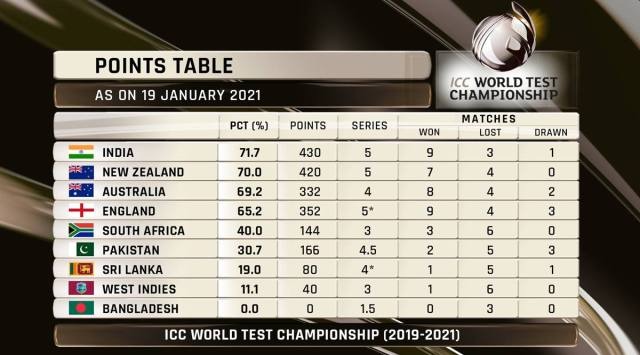
NRR is how fast a team scores minus how fast it concedes, in runs per over across all its counted matches. A positive number means faster aggregate scoring. +0.500 is a half-run-per-over advantage, and −0.500 is an equal disadvantage. If Team A scores 160 in 20 overs and concedes 140 in 20 in its only counted match, its NRR is +1.000. In the IPL 2026 and ICC Men's T20 World Cup 2026 group standings, wins are considered before NRR when teams are tied on points.
How to Calculate Tournament NRR
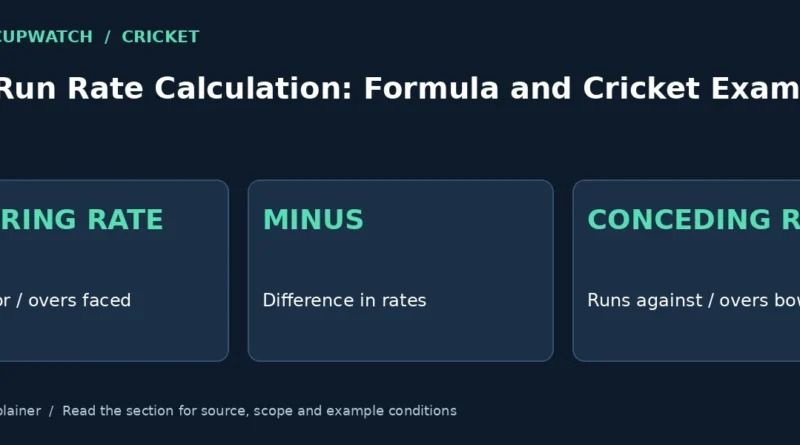
Both halves of the formula use the same set of matches, with any overs adjustments the event rules require.
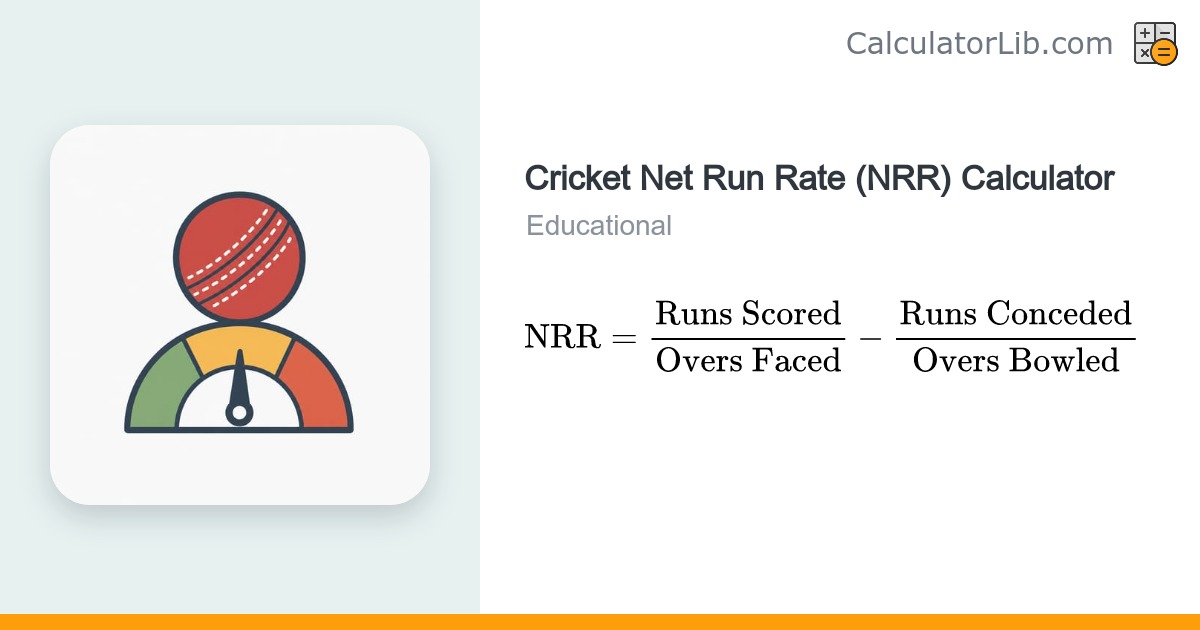
Formula: NRR = (total credited runs scored ÷ total credited overs faced) − (total credited runs conceded ÷ total credited overs bowled).
If you store durations as legal balls, use NRR = 6 × [(runs scored ÷ credited balls faced) − (runs conceded ÷ credited balls bowled)]. In a spreadsheet this keeps the ball totals as whole numbers until the final division.
The ICC Men's T20 World Cup 2026 playing conditions list which inputs count and which competition phases are eligible for that event.
A two-match example
Take two uninterrupted T20 matches with made-up numbers. In the first, Team A bats its full 20 overs. In the second, it completes a quick chase.
| Counted match | Runs scored / credited overs | Runs conceded / credited overs | Match rate difference |
|---|---|---|---|
| Match 1 | 180 / 20 | 160 / 20 | +1.000 |
| Match 2 | 110 / 10 | 108 / 20 | +5.600 |
| Combined | 290 / 30 | 268 / 40 | +2.967 |
The second match is a chase completed without a wicket lost, so Team A faces just ten overs while its opponent uses twenty.
Across both matches, 290 ÷ 30 = 9.666667 runs scored per over and 268 ÷ 40 = 6.700000 conceded. The difference is +2.966667, shown as +2.967 to three decimal places. The NRR calculation walkthrough shows the credited ball totals behind a rounded NRR figure, so you can find where a discrepancy starts.
Average the two match differences instead and you get (1.000 + 5.600) ÷ 2 = +3.300. That's the wrong figure. The pooled result is +2.967.
How to Read 18.4 Overs Correctly
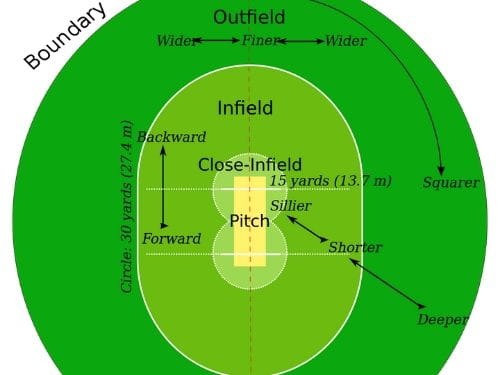
The dot in cricket overs notation separates completed overs from legal balls in the next over. An innings listed as 18.4 overs lasted 18 complete overs plus four legal deliveries.
Six legal balls make an over: 18 × 6 + 4 = 112 legal balls, or 112 ÷ 6 = 18.666667 overs. The digit after the dot in an incomplete over runs from zero to five. So 16.4 means 100 legal balls, 17.3 means 105, and 20.0 means 120.
A real IPL match shows the decimal error
On April 10, 2021, Chennai Super Kings made 188/7 in 20 overs. Delhi Capitals reached 190/3 in 18.4 overs, winning by seven wickets, as recorded in the official IPL match report.
A viewer trying to reproduce Delhi's opening-match NRR got a different number:
In match 2 of 2021 ipl between csk and dc, csk scored 188-7 (20) and dc chased it with 190-3 (18.4). Now if we calculate the net run rate, it comes out to be 190/18.4 - 188/20 = 0.926. However in the match replay the points table was updated with dc being given 0.78 score. Considering this was the 1st match for both teams, it does not seem to be a technical error. Can anyone explain this?
Delhi's scoring rate is 190 × 6 ÷ 112 = 10.178571 runs per over. Chennai's rate was 188 ÷ 20 = 9.400000. The difference is +0.778571, which shows as +0.779 to three decimals or +0.78 to two.

The viewer's decimal input, 190 ÷ 18.4 − 188 ÷ 20, produces +0.926087.
Wides and no-balls add runs without adding a legal ball to the over, so runs and legal-ball duration have to be entered separately.
What Happens When a Team Is All Out Early?
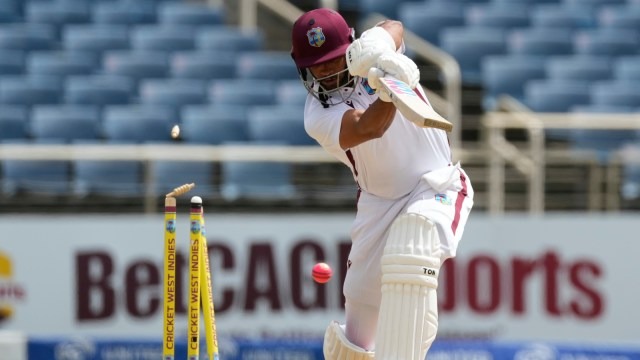
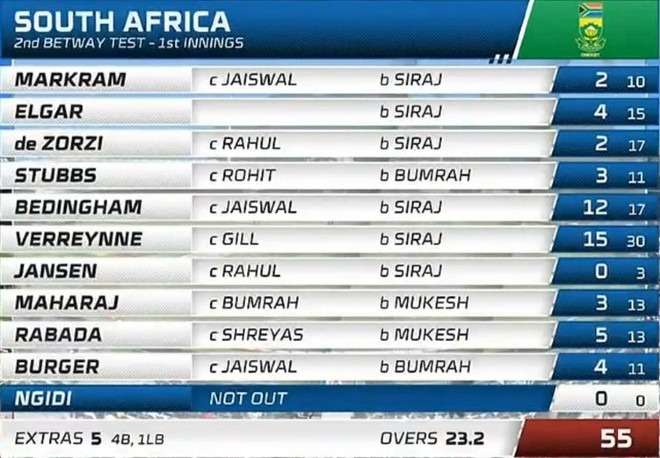
When a team is dismissed before using its allotted overs, the ICC and IPL 2026 rules charge that innings with its full entitled allocation for NRR. A team all out after twelve overs of an uninterrupted twenty-over innings gets a twenty-over denominator.
Suppose Team B scores 150 in 20 overs and Team A is all out for 140 after 12. The table shows how much the denominator matters, using made-up numbers.
| Input or outcome | Full entitlement (correct) | Scorecard duration (wrong) |
|---|---|---|
| Runs scored / conceded | 140 / 150 | 140 / 150 |
| Credited overs faced / bowled | 20 / 20 | 12 / 20 |
| NRR for Team A | −0.500 | +4.167 (wrong) |
A successful chase completed without the batting side being all out uses its credited batting duration. After a rain reduction, the full entitlement is shorter than twenty overs.
Which Matches Count After Rain, No Result or a Super Over?

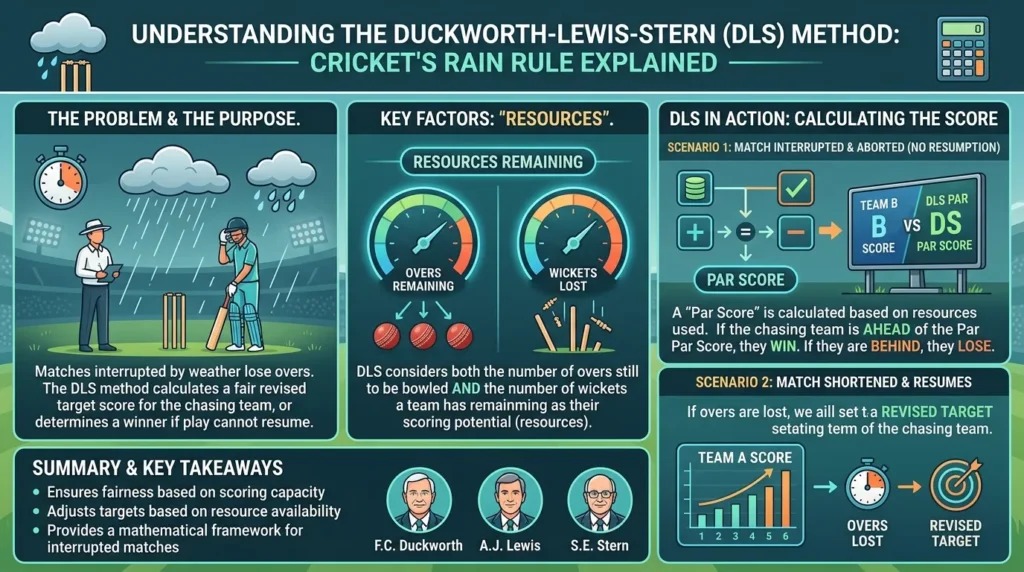
How an interrupted match counts depends on its result. A no-result is excluded. A DLS-awarded result is not. The 2026 ICC and IPL rules set this out.
The IPL 2026 Match Playing Conditions give separate NRR credits for a DLS result awarded after abandonment and for a completed chase with a revised target.
| Match or stage | NRR handling | Rule context |
|---|---|---|
| Completed match with a result | Officially credited innings totals are used | ICC / IPL 2026 |
| Early all out | The dismissed side is credited its full entitled overs | ICC / IPL 2026 |
| Abandoned with no result | Excluded from NRR | ICC / IPL 2026 |
| Abandoned, DLS result awarded | First-innings credit is the second team's par score at abandonment, over the matching overs | IPL 2026 |
| Completed after earlier DLS revision | First-innings credit is one below the final target, over the revised allotted overs | IPL 2026 |
| Super Over or forfeit | Super Over scores are excluded; forfeits follow the event's special rule | ICC T20 World Cup 2026 |
| Competition phase or playoffs | Super Eights start with fresh NRR; IPL playoff games are excluded from regular-season NRR | ICC / IPL 2026 respectively |
Afghanistan versus Bangladesh: the revised target matters
In a rain-affected 2024 Men's T20 World Cup Super Eight match, Afghanistan scored 115/5 in 20 overs. Bangladesh was all out for 105 in 17.5 overs after its chase target had been revised to 114 from 19 overs. Afghanistan won by eight runs under DLS.
A reader wondered which Afghanistan innings figure belonged in the NRR calculation:
AFG originally scored 115 in 20 overs. However, due to rain the revised target was 114 in 19 overs. Which means AFG's revised total is 113 in 19 overs. So for NRR purposes, will AFG's score be taken as 115 in 20 overs or the revised 113 in 19 overs?
Clause 16.10.9 of the ICC Men's T20 World Cup 2024 playing conditions settles it. Afghanistan is credited with 113 runs in 19 overs for this completed DLS-adjusted game, and Bangladesh's 105 all out is credited over its full revised 19-over entitlement.
Afghanistan's match-level rate difference is 113 ÷ 19 − 105 ÷ 19 = 8 ÷ 19, about +0.421 runs per over. Its cumulative Super Eight NRR also depends on its other counted games.
Can Winning Lower Your NRR?
A win can lower a cumulative NRR when its own rate difference is weaker than the team's prior aggregate, even though the team still gains the win in the standings.
In a made-up 20-over match, Team A scores 180 and concedes 140. With 20 credited overs on each side, its NRR after one match is (180 − 140) ÷ 20 = +2.000.
Team A then wins again, scoring 151 and conceding 141 in another full-length match. That match has a rate difference of +0.500.
Combined NRR after two wins is (180 + 151) ÷ 40 − (140 + 141) ÷ 40 = 331 ÷ 40 − 281 ÷ 40 = +1.250. The second victory added a smaller rate advantage, so the +2.000 aggregate fell to +1.250.
A narrow wicket margin and a high NRR
Now take a different made-up 50-over match. Team B is all out for 120 after 40 overs and receives a full 50-over NRR denominator. Team A scrapes home at 121/9 in 25 overs, with one wicket left.
Team A's match rate difference is 121 ÷ 25 − 120 ÷ 50 = 4.840 − 2.400 = +2.440. With nine wickets lost, the chase was precarious. NRR counts runs per credited over, and wickets lost only matter when a side is all out, because that sets its overs entitlement.
Why Your Calculated NRR Doesn't Match the Official Table

When your NRR doesn't match the table, check two things: whether your own arithmetic reproduces the calculation you intended, and whether the competition counts the same matches and inputs you used.
A Reddit user building an IPL app described a mismatch after eight Gujarat Titans matches:
I’m trying to build a small app to calculate Net Run Rate (NRR) for IPL teams using official ICC rules, but I’m getting slightly different results compared to the actual points table. For example, for Gujarat Titans (first 8 matches performance in IPL 2026): My calculated NRR (using ball-based method): -0.494 Official NRR (points table): -0.475
The same author reported 1,389 runs scored, 1,491 conceded, 926 balls faced and 942 balls bowled. Those numbers give:
NRR = 6 × [(1389 ÷ 926) − (1491 ÷ 942)] = 9.000000 − 9.496815 = −0.496815, or about −0.497.
The author calculated −0.494 and reported −0.475 in the official table. Their own inputs give −0.497.
A six-step discrepancy check
- Fix the match set. Record the competition, stage, cutoff and number of matches the table represents. A result entered after the cutoff changes the totals.
- Compare the two run totals. Check scored and conceded runs against the match records, including any published corrections.
- Audit the credited balls. Convert scorecard overs to legal-ball counts and add the batting and bowling denominators separately.
- Apply the innings entitlement. Identify all-out innings and reduced allocations, then use the overs entitlement that competition requires.
- Resolve match states. Use the official result and the DLS, no-result, Super Over, forfeit and phase rules that apply to that event.
- Round only the displayed result. Calculate from unrounded aggregate totals and compare at the points table's precision.