Strike rate is runs divided by balls faced, times 100. It shows how fast a batter scored, not whether the innings helped. Judge that against the target, batting position and phase of play. Start with R and BF on the scorecard.
What Does Batting Strike Rate Mean?
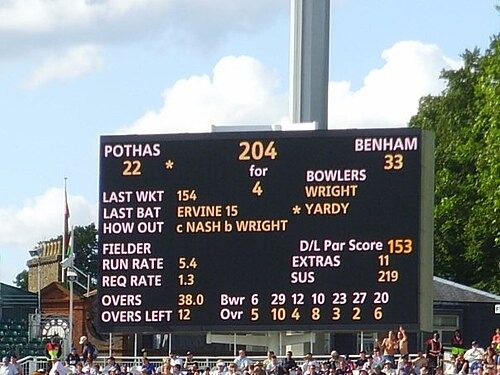
Batting strike rate (SR) is an individual batter's scoring speed, expressed as runs per 100 balls faced. An SR of 150.00 means 1.5 batter runs per ball, or 150 runs per 100 balls. On a scorecard, R is the batter's runs and BF is the number of deliveries that batter faced.
How to Calculate Batting Strike Rate
To calculate batting strike rate, divide the batter's runs (R) by their balls faced (BF) and multiply by 100:
Batting SR = (R ÷ BF) × 100
Say a batter scores 45 runs from 30 balls, written “45 off 30.” Dividing 45 by 30 gives 1.5, and multiplying by 100 gives a strike rate of 150.00.
| Runs (R) | Balls faced (BF) | Batting SR |
|---|---|---|
| 45 | 30 | 150.00 |
| 60 | 80 | 75.00 |
| 5 | 1 | 500.00 |
| 0 | 10 | 0.00 |
| 0 | 0 | Undefined |
The five-run, one-ball innings produces 500.00 because the denominator is a single ball. It describes a very small sample.
When BF is zero, the result is undefined, because you cannot divide by zero. Some scorecards leave the field blank or show a dash. Scorecards show two decimal places.
Which Runs and Balls Count? No-Balls, Wides, and Extras
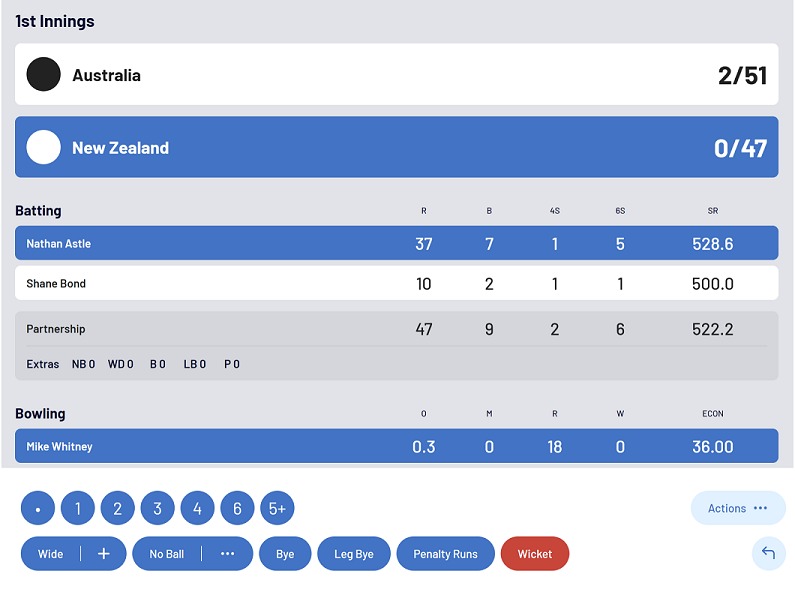
Batting SR uses runs credited to the batter and the balls that batter faced. Balls faced and the legal balls of an over are separate counts, and wides and no-balls are where they differ.
A no-ball the striker faces counts as a ball faced. It does not count as one of the six legal balls in the over. A wide counts toward neither the striker's BF nor the legal balls of the over.
| Delivery | Batter runs added | BF added | Legal over balls added | Team extras |
|---|---|---|---|---|
| Ordinary dot ball | 0 | 1 | 1 | None |
| Legal delivery hit for four | 4 | 1 | 1 | None |
| No-ball hit for four | 4 | 1 | 0 | No-ball penalty |
| Wide with no additional runs | 0 | 0 | 0 | Wide penalty |
In the no-ball row, the four runs from the bat belong to the batter and the penalty goes to team extras, so the over still needs another legal delivery. Byes and leg byes also add to the team's total without increasing the batter's R.

A team's total can therefore rise even when the striker scores no personal runs. If the BF looks wrong after an illegal delivery, check the scorecard's R, BF, and Extras entries. For unusual cases, the official scorecard and the match's playing conditions decide. The MCC Laws of Cricket explain how overs and deliveries work.
For the other batting and bowling columns, see the guide to reading a cricket scorecard.
How to Calculate Strike Rate Across Multiple Innings
A season or career strike rate is total batter runs divided by total balls faced across the included innings, multiplied by 100. Every ball faced counts equally.
Two fictional innings of very different lengths show the difference:
| Innings | Runs | Balls faced | Strike rate |
|---|---|---|---|
| A | 10 | 5 | 200.00 |
| B | 30 | 30 | 100.00 |
| Both combined | 40 | 35 | 114.29 |
A simple mean of the two innings rates is 150.00. The pooled calculation uses all 40 runs and 35 balls: 40 ÷ 35 × 100 = 114.29. The 30-ball innings contributes six times as many balls as the five-ball innings.
A not-out innings adds its runs and balls to the combined strike rate like any other innings.
What Is a Good Strike Rate in T20, ODI, or Test Cricket?

There is no universal cutoff for a good batting strike rate across formats. Compare batters in the same format, role and innings phase.
- T20 cricket: A standard innings has up to 20 overs, so scoring pace matters most. An opener may build an innings across several phases, while a finisher may have only a few balls to attack.
- ODI cricket: A standard innings has up to 50 overs. The right pace shifts as the side builds a total, preserves wickets, and accelerates late.
- Test cricket: Staying at the crease can be worth more than quick runs when time, wickets and the match position call for patience. A slow rate can be exactly the job.
In a chase, look at the runs still needed and the balls remaining. A side needing nine runs per over needs 1.5 team runs per legal ball. A batting SR of 150 means 1.5 runs credited to one batter per ball that batter faces. The chase depends on the team's total scoring across its remaining legal balls.
A 2024 study examined 4,221 men's T20 international batting innings in which the batter scored at least 25 runs. It reported differences in mean strike rates between the first and second innings of a match and across countries of play.
Batting position matters separately. An opener's 40-ball effort and a finisher's four-ball cameo are different jobs, even when their recorded SR matches. Opposition, pitch conditions, and era also explain differences between performances.
For the broader differences between formats, see T20 vs. ODI vs. Test cricket, which covers innings, over limits, and scoring roles.
Batting Strike Rate vs. Batting Average: What's the Difference?
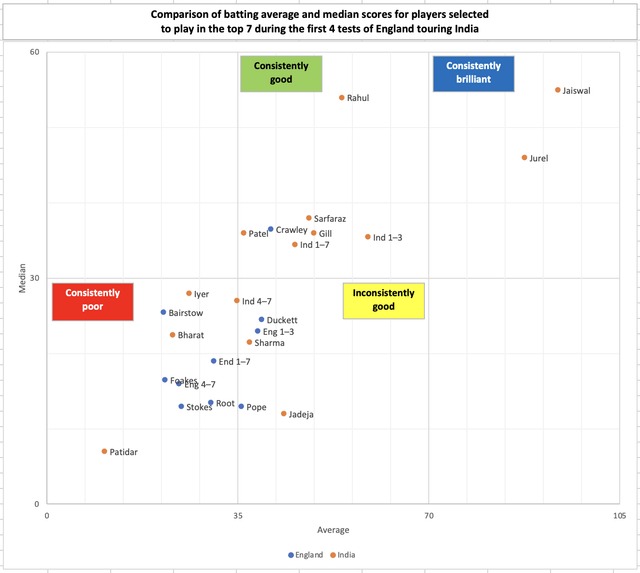
Batting strike rate measures runs per 100 balls faced. Batting average measures runs per dismissal: total batter runs divided by the number of times the batter was out. Strike rate is also a different measure from bowling economy or tournament NRR; the cricket statistics guide separates those metrics.
Two players can score at a similar pace yet build innings very differently. A batter who scores quickly in brief appearances tells you something different from one who regularly makes large scores. Check total runs and batting average alongside SR.
Not-out innings count toward the runs and balls in batting SR. For batting average, the denominator counts dismissals.
A 2015 study of player evaluation in Twenty20 cricket, using 282 historical matches, explored expected run differential as a broader way to judge contributions.
Scorecards show other rates with different denominators. Bowling strike rate is balls bowled per wicket taken, and bowling economy is runs conceded per over. Team run rate is scoring per over, and required run rate is the pace needed to chase a target. The team run rate and required run rate guide covers the chase calculation.
Why Equal Strike Rates Can Mean Different Contributions
Suppose one batter makes 6 runs off 4 balls while another makes 60 off 40. Both finish with SR 150.00. The second batter scores ten times as many runs and faces ten times as many balls.
In a hypothetical chase that needs six runs, six off four balls completes the target. In a much larger chase, 60 runs still leaves the side short if the team scores below the required rate across its remaining legal deliveries.

Wickets shape the game state too. Losing a batter changes the options for the players who follow, and strike rate does not record that effect.