Start with the batter's off side and leg side. Each position name gives a direction and a distance from the bat, and the bowler's plan explains why a fielder stands there. For a left-hander, reverse the sides in the same field-map view, then check the restrictions of the actual match.
How to read a cricket field map: start with the batter
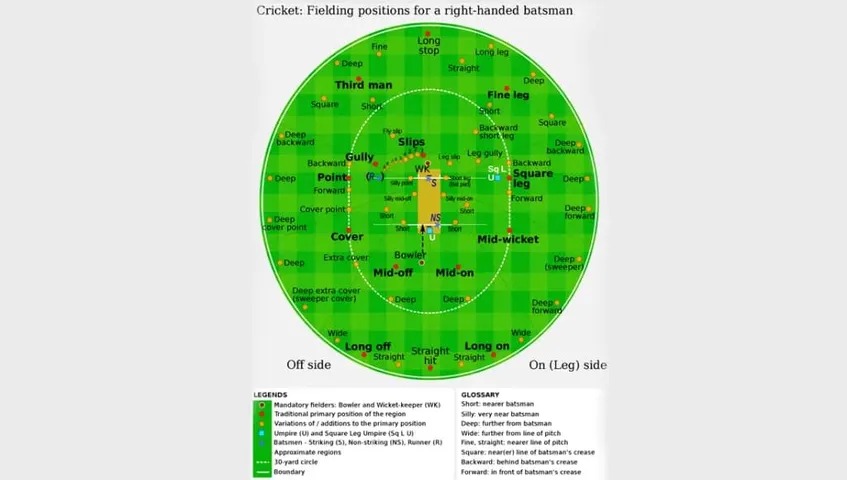
Picture the striker at the batting wicket, facing the next delivery. The bowler approaches from the opposite wicket, and the wicketkeeper stands behind the batter's stumps. Those three players fix the viewpoint for every other position.
For a right-handed batter, the off side lies away from the legs. The leg side, also called the on side, lies toward them. A line running sideways through the batter's wicket marks square of the wicket. An area toward the wicketkeeper is behind square, and one toward the bowler is in front of square.
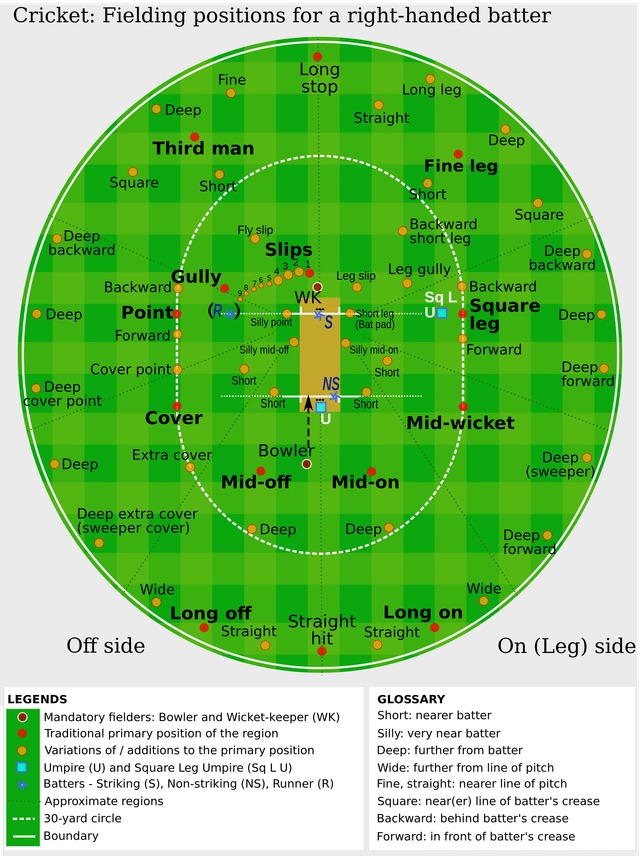
Depth matters too. A slip stands close to the wicketkeeper for a catch. Point and cover work in the inner field, where a quick stop prevents a single. Long-on is much farther out, protecting a straightish leg-side route toward the boundary.
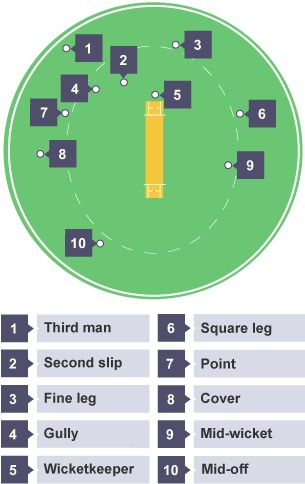
A teaching map can label twenty positions at once, but a full-strength fielding side has only eleven players, including the bowler and wicketkeeper.
Where are the main fielding positions? Off side and leg side
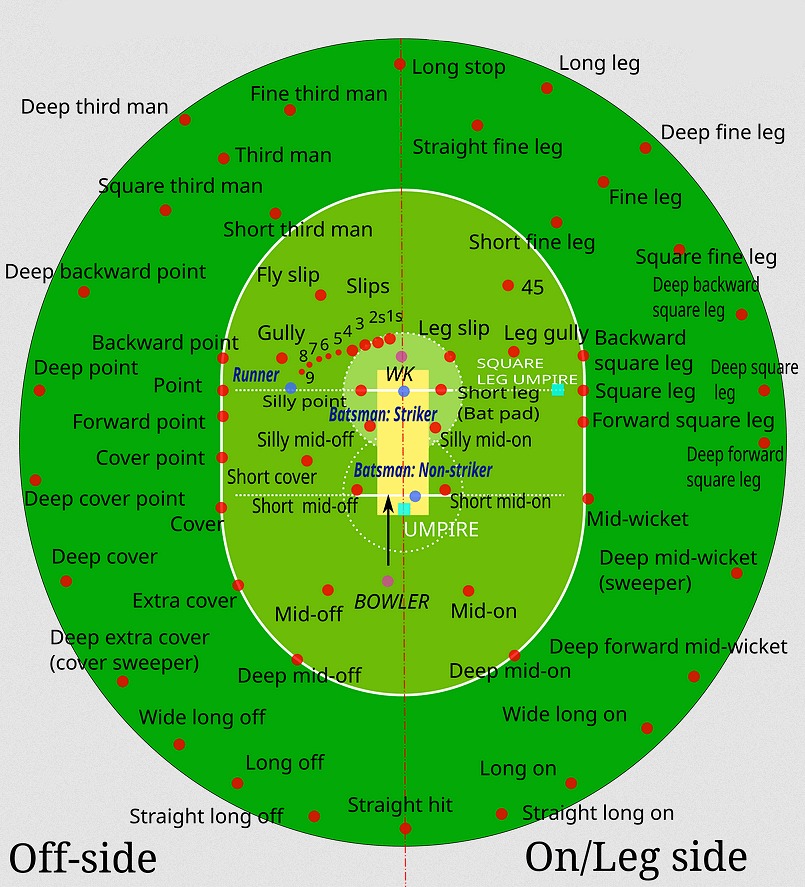
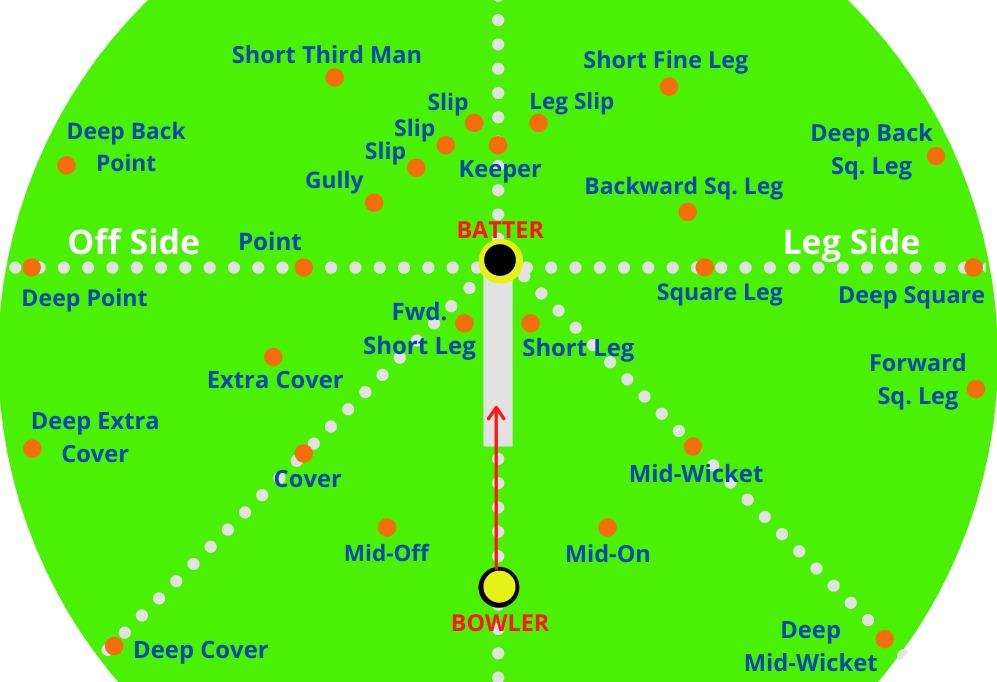
Fielding positions are named zones around the batter. This reference for a right-handed batter groups the most recognizable ones by side and angle.
| Position | Side and location | Typical role |
|---|---|---|
| Slip | Off side, close behind the batter beside the wicketkeeper | Catch an outside edge |
| Gully | Off side, between slip and point | Catch a wider edge |
| Point | Off side, square of the wicket | Stop cuts and save singles |
| Backward point | Off side, behind square | Cover cuts behind square |
| Cover | Off side, in front of square | Stop drives |
| Extra cover | Off side, between cover and mid-off | Guard a more forward driving area |
| Mid-off | Off side, straight toward the bowler | Stop straighter off-side drives |
| Third man / deep third | Off side, behind square toward the boundary | Protect against edges and deflections |
| Mid-on | Leg side, straight | Stop straighter on-side strokes |
| Midwicket | Leg side, between mid-on and square leg | Guard on-side drives and pulls |
| Square leg | Leg side, square of the wicket | Cover flicks and pulls |
| Fine leg | Leg side, behind square at a finer angle | Guard fine deflections |
| Deep midwicket | Leg side, near the midwicket boundary | Protect against powerful on-side hits |
| Long-on | Leg side, deep and straight | Guard lofted straight on-side shots |
| Long-off | Off side, deep and straight | Guard lofted straight off-side shots |
| Silly point | Off side, extremely close to the batter | Seek a close catch |
| Short leg | Leg side, extremely close to the batter | Seek a close catch |
| Leg slip | Leg side, close behind the batter | Catch a leg-side glance or deflection |
The trickiest boundaries sit around the wicketkeeper. Slip is beside the keeper, gully spreads farther toward point, and leg slip is on the opposite side of the batter. Fine leg lies in a similar behind-square direction to leg slip, but much farther from the bat.
What do deep, short, backward, square and silly mean?
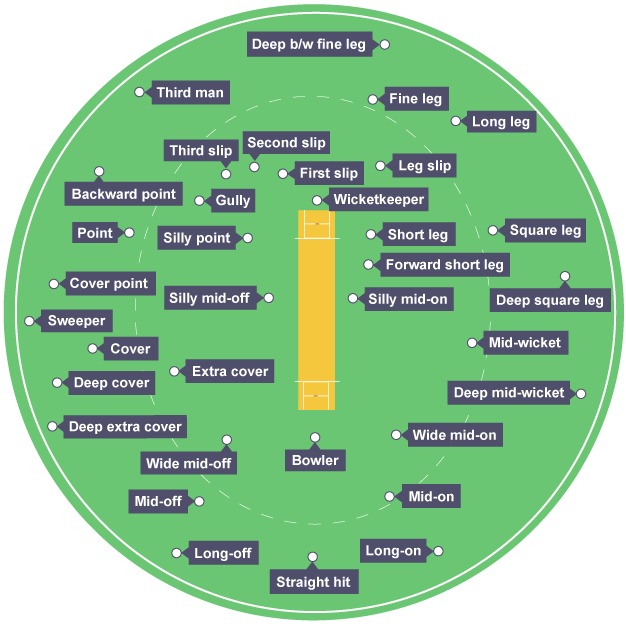
Long compound names become manageable when you separate the base position from the words describing its angle and distance.
| Word | Usual meaning | Example |
|---|---|---|
| Deep | Farther toward the boundary | Deep midwicket |
| Long | Deep, near a straighter sector | Long-on |
| Short | Closer to the bat than the usual spot | Short fine leg |
| Silly | Extremely close to the batter | Silly point |
| Backward | Farther behind square | Backward point |
| Forward | Farther in front of square | Forward square leg |
| Square | Level with the striker, across the wicket | Square leg |
| Fine | At a narrower angle behind the wicket | Fine leg |
| Wide | Farther around the fielding arc from a straighter line | Wide long-on |
| Straight | Nearer the lengthwise line of the pitch | Straight mid-off |
Deep backward square leg shows the method. Square leg gives the leg-side region, backward moves it behind square, and deep puts it toward the boundary. Backward point starts on the off side, then shifts behind square.
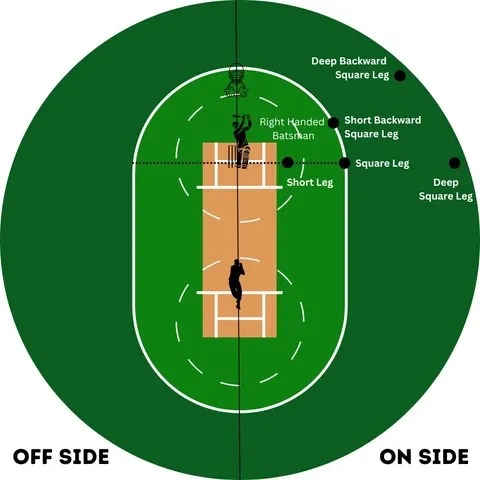
None of these words carries a standardized distance in yards.
What changes when a left-handed batter is on strike?
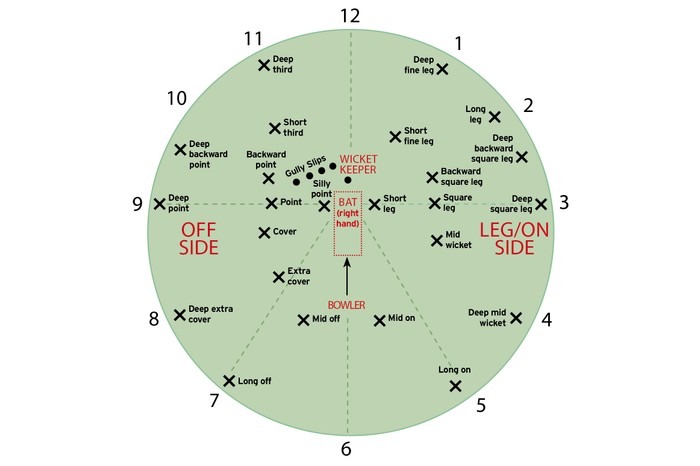
With the viewpoint fixed, a left-hander flips the picture, because sides follow the batter's stance. Cover stays on the off side and square leg stays on the leg side, but each now sits on the opposite half of the diagram. Third man and fine leg swap the same way: deep third is still behind square on the off side, and fine leg is still behind square on the leg side. The captain then reshuffles the field for the new batter, so the players rarely form an exact mirror image.
Why do captains put fielders in attacking or defensive positions?
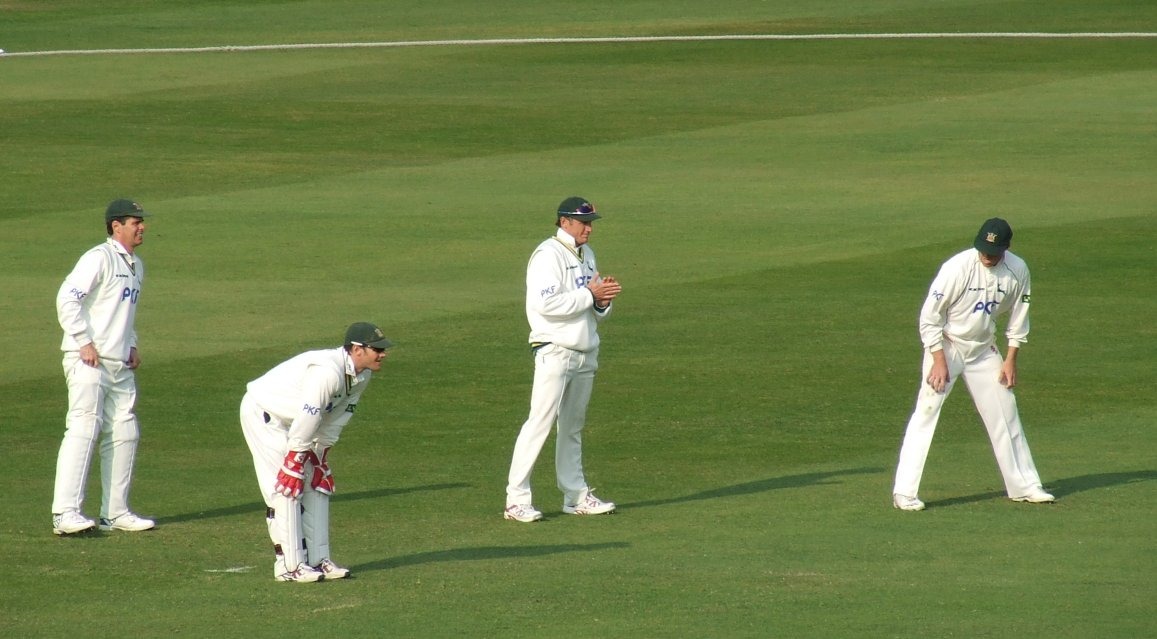
A captain's field reflects a plan for the next deliveries. Slips and gully offer catching chances from edges. Point and cover stop ground shots before batters run. Deep fielders guard selected routes to the boundary.
| Emphasis | What it covers | What it gives up |
|---|---|---|
| Close catching | Edges and deflections near the bat | Some deep scoring lanes |
| Inner-field protection | Ground shots and quick singles | Some lofted shots beyond the ring |
| Boundary-conscious coverage | Selected deep hitting areas | Close catching options and sometimes singles |
Suppose a captain plans for outside edges with two slips and a gully. If the captain moves the second slip to deep third, the team gains a boundary fielder behind square on the off side and loses a catching position beside the wicketkeeper. The move makes sense when the captain expects edges or deflections to reach the deep third region and wants to save those runs.
Two complete field-setting illustrations
Each list below accounts for all eleven members of the fielding side.
- A. Close-catching emphasis: bowler (1), wicketkeeper (1), two slips (2), gully (1), point (1), cover (1), mid-off (1), mid-on (1), square leg (1) and fine leg (1). Total: 11. The two slips and gully create chances for catching an outside edge.
- B. Boundary-conscious emphasis: bowler (1), wicketkeeper (1), deep third (1), deep backward square leg (1), long-on (1), long-off (1), cover (1), point (1), mid-off (1), midwicket (1) and fine leg (1). Total: 11. This setup guards four deep sectors.
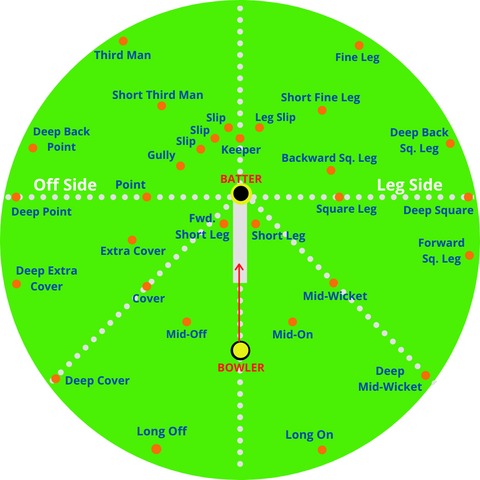
List B puts fine leg and deep backward square leg behind the popping crease as its two leg-side fielders there. With four deep players, the competition's boundary restrictions also come into play.
Field plans also follow the bowler's line and length, the batter's favored shots and the stage of the innings. Bowl to your field means encouraging shots toward the players already in place to handle them.
In ten matches from Australia's 2022/23 Big Bash League, researchers examined 1,964 deliveries and recorded 1,694 primary fielding instances, 63.3% of them in the infield. The professional men's T20 study describes positional involvement in that sample, which varied with match phase and bowling type. Placements also depend on the expected delivery, and the bowling types guide distinguishes movement from swing, seam, spin and bounce.
How to read a field setting when you are watching cricket
A television close-up leaves much of the field out of frame, although some broadcasts show a wider view or a field map. Four clues tell you what the captain is doing: the batter, the position the commentator names, the shot area it protects and the area getting less coverage. When you hear “third man goes deeper,” picture stronger protection behind square on the off side. “Two slips in place” points to outside-edge catches.
What fielding restrictions apply, and when must you check them?
Position names are flexible. The Laws and a competition's playing conditions decide whether an arrangement is allowed. The MCC's 2017 Code, fourth edition (2026), took effect on October 1, 2026. Its Law 28 deals with fielders' positions and conduct.
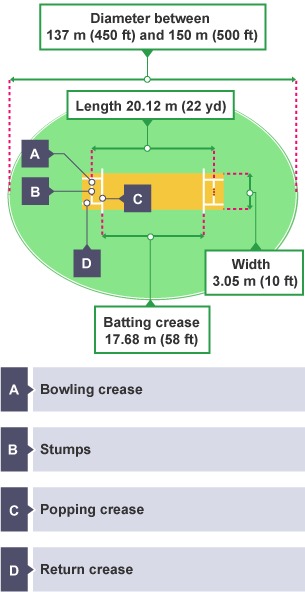
At the batter's end, behind the popping crease means the side of that line toward the wicketkeeper's end. Under Law 28.4, at the instant of delivery, no more than two fielders other than the wicketkeeper may be behind the popping crease on the on side. A breach results in a No ball.
Law 28.5 covers fielders encroaching on the pitch in the circumstances it specifies, and Law 28.6 restricts particular fielder movements before the ball reaches the batter. The wider rules governing cricket fielders explain both in context.
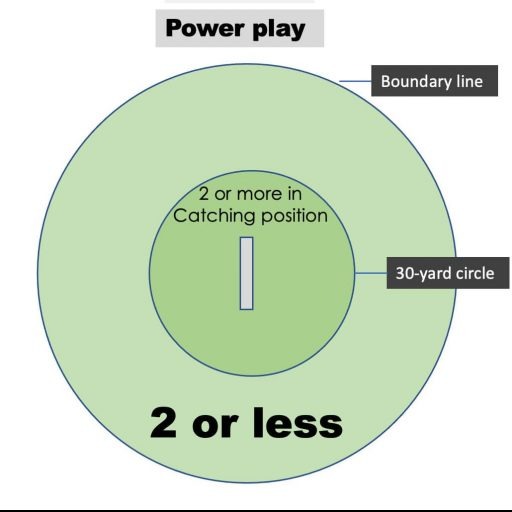
Limited-overs competitions add fielding-circle and Powerplay restrictions. The ICC playing conditions apply to their designated international formats, and other competitions set their own. A field with four deep players may be allowed in one phase and restricted in another. The separate guide to Powerplay fielding restrictions, including how fielders, overs, and match conditions interact, covers that format-specific question.
Close catchers at silly point and short leg need suitable protection in hard-ball cricket.
For an actual field, count everyone including the bowler and wicketkeeper, identify any on-side player behind the popping crease, and apply the rules for that competition and innings phase.
How to remember fielding positions before your first match
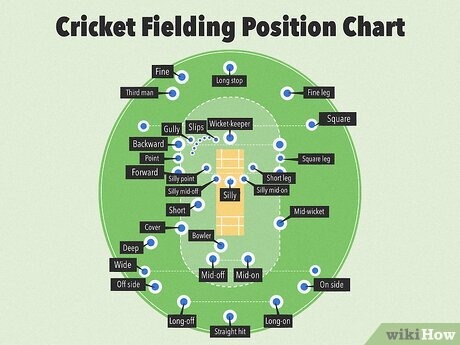
A few opposite-side pairs make a position call easier to follow. These anchors help a new player navigate the ground:
- Mid-on and mid-off: straight positions on opposite sides of the batter.
- Point and square leg: the two square-of-the-wicket regions, one on each side.
- Third man and fine leg: behind-square regions on opposite sides.
- Long-on and long-off: deep positions toward the straight boundaries.
A new club player described the anxiety of receiving an instruction without knowing any of the fielding labels:
Hey lads, I’m (28M) playing my first ever cricket game this weekend, and getting the jitters. I’ve only played some backyard cricket as a kid (only batted), but never any proper cricket. I joined a local friendly cricket club and have been included in the XI for a game this weekend. I’d just be batting (maybe) and fielding - but I’m dreading the day because I have absolutely no idea what goes around on/off the pitch. While fielding would the captain say the name of the field position and ask you to be there, like “go to Long On” or do they guide you a bit? Because I have no idea about the field positions..
“Go to long-on” means deep on the batter's leg side, near the straight boundary. The captain can point out a more exact spot.
In a 60-second exercise, you draw a ground, mark the striker and bowler, and use movable tokens for a few named positions. You place one opposite-side pair, then move a token to match a compound call such as deep backward square leg.
Once the location names are familiar, beginner cricket fielding drills using fielders, a soft ball and catching practice cover the separate skills of catching, throwing and movement.